Voice Assistant Technology & AI Trends in 2026
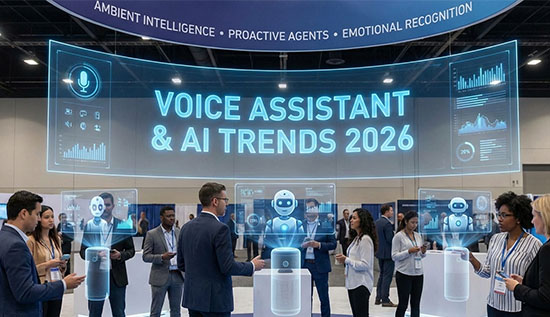
Future-ready voice assistant technology in 2026 with AI-powered conversations, smart speakers and evolving voice interaction experiences.
Voice assistant technology has rapidly evolved from simple command-based systems into intelligent conversational platforms powered by advanced artificial intelligence. What began as basic tools for setting alarms or asking for weather updates has transformed into AI-driven assistants capable of understanding context, emotions, and complex tasks.
In 2026, voice assistants are no longer limited to smartphones or smart speakers. They are embedded across cars, workplaces, healthcare systems, smart homes, and enterprise platforms, enabling seamless hands-free interaction with digital services.
The biggest transformation driving this shift is the integration of generative AI and large language models (LLMs) into voice interfaces. Instead of responding with pre-programmed answers, modern assistants can generate natural conversations, provide personalized recommendations, and perform multi-step tasks.
Technology companies are investing heavily in this space. Platforms such as Google Assistant, Amazon Alexa, and Apple Siri are evolving into smarter AI copilots that integrate across devices and services. At the same time, businesses are deploying AI voice agents in customer support, sales, and automation systems, making voice technology a core part of digital transformation strategies.
As we move through 2026, voice assistants are becoming one of the most natural ways humans interact with technology.
This article explores how voice assistants will evolve by 2026, examining the technologies behind them, real-world applications, and future trends. You’ll also learn about the impact of AI on voice recognition technology, clear-cut cases of this being done and its impact on businesses and customers.
Evolution of Voice Assistant Technology: From Commands to Conversations
The journey of voice assistant technology, the experience has been amazing, changing from simple command-based tools to complex conversational friends. In the beginning, voice assistants could only understand simple orders like "start playing music" or "set alarm" and were unable to communicate with people very frequently.
Today, their bodies understand significance, emotion, along with purpose, which lets consumers have smooth, human-like conversations. This evolution reflects the broader trend of voice AI technology trends, where systems are not only reactive but proactive, predicting user needs and generating personalized recommendations.
Businesses, developers and customers who want to take advantage of the full potential that comes from this evolution need to understand its implications of voice interaction technology in 2026.
Technological Milestones in Voice Assistants
Voice helpers have gotten better in a number of significant manners over the span of time:
- Natural Language Understanding (NLU): Let's discuss how systems understand every meaning of words, in addition to key ones that are important.
- Generative AI Integration: This facilitates computer helpers come up with new answers on the spot instead of using ones that were written ahead of the actual event.
- This function makes you pick up where you left off in a conversation, as long as you use the same methodology.
- Emotion and Sentiment Analysis: Voice helpers can change the manner in which they communicate and behave depending upon the way their thoughts make you feel.
- Multilingual Support: Recognizing and translating languages and pronunciations is now nearly automatic.
Step-by-Step: How Modern Voice Assistants Think
- Speech Capture: High-tech microphones remain capable of picking up your words regardless of whether it's crowded.
- Translation of Speech Processing: Applies deep learning models to transform words that are spoken out loud into correct written content.
- Intent Recognition: Artificial Intelligence examines at more than exclusively terms; it additionally looks beginning at context and meaning.
- Situational memory: remembers the things that are being discussed so that you can respond more intelligently.
- Response Generation: Artificial intelligence that generates makes normal, responses that are customized.
- Speech Output: Transform AI-written text into a voice command that sounds like an actual individual.
Examples of Application scenarios
- Smart Home Automation: A particular individual says, "Here is too bright." Without being told what to do, the assistance worker dims the lights, adjusts the blinds, and broadcasts calm soundtrack.
- Workplace Productivity: Employees encourage the assistant about arranging meetings, make correspondence, or summarize emails. These actions make things perform more effectively.
This evolution showcases how voice assistant technology has matured, making interactions more conversational, intuitive and integrated into daily life.
Major Platform Innovations: Google, Alexa, and Siri in 2026
As voice assistant technology evolves, new features that work only on certain platforms have become very important for making products different from each other. Google, Amazon, and Apple are all big ecosystems that are changing what people expect from AI-powered voice assistants. At this point, these systems stress correct answers as well as personalization, security, and the ability to work across multiple devices.
In 2026, voice assistant trends in 2026 with examples show that the competition among these tech giants is pushing rapid advancements in voice interaction technology, generative AI and environmental intelligence. People can determine the best helper for their lives by knowing concerning these fresh instruments, and businesses have the ability to positive their customers have the best possible experience alongside artificial intelligence.
Google Assistant Advancements
- Situational Memory: Google Assistant remembers questions you've asked before so that it can help you by providing better, ongoing conversation.
- Multimodal Intelligence: It uses writing, voice, and visual cues to provide you interactive experiences.
- Proactive Suggestions: Makes helpful recommendations for things including reminders, destinations or media based on the manner in which the user conducts themselves.
Example: Someone who additionally is looking for recipes gets detailed cooking instructions, with photographs on smart display devices, and more without having to put forward an additional question.
Alexa Voice Assistant for Artificial intelligence Generation
- Dynamic Conversational Knowledge: Using generative AI, Alexa is now capable of providing you answers that sound realistic alongside are based on what's happening in the discussion at hand.
- Commerce Integration: It assists when you shop by tracking deals, suggesting goods, and comparing expenses.
- Custom Skills Expansion: Developers are able to develop AI-driven skills that let users have their own unique experiences.
Example: Alexa may perform conversational shopping, suggesting merchandise, answering questions, and completing orders, all with speaking commands.
Siri AI Improvements 2026
On-Device Intelligence: Does things offline to protect privacy and accelerate up performance.
- Apple Ecosystem Integration: This functionality makes iPhones, Macs, iPads and HomePods sync without any problems at all.
- Health and Fitness Integration: It tracks what the individual does, provides specific advice on how to be healthy, and answers health questions in a thoughtful manner.
Example: Fortunately, someone asks Siri to plan a week's worth of exercise, Siri makes a program, connects through the user's devices and modifications the plan based on the manner in which they're exercising every single day.
The combination of Google Assistant advancements, Alexa generative AI voice assistant, and Siri AI improvements 2026 highlights how competition drives innovation, shaping the future of voice assistant technology.
AI Voice Assistants in Cars, Devices and Everyday Life
Beyond homes and smartphones, AI voice assistants in cars and devices are changing the manner in which people employ technological devices in every aspect of their lives. Voice interfaces can do much more than simply ask questions or broadcast music.
They are now smart companions the fact that are built into cars, wearable technology, sophisticated goods, enterprise applications, and infrastructure throughout the world.
By 2026, voice interaction technology is now necessary for rendering digital experiences more secure, quicker and more intuitive, especially when one does not have safe or straightforward to use a screen. This widespread adoption reflects broader voice AI technology trends, where making decisions on the spot, hands-free contact, and personalized help are most important.
More and more, people expect speech assistants to understand what they're doing, remember how they like things done, and help them without having to be told over and over again.
At the same time, companies and coders who are using voice assistant technology benefit from higher engagement, improved accessibility and streamlined operations. As voice becomes the most natural interface for human communication, its integration into everyday environments continues to accelerate.
AI Voice Assistants in Vehicles
Modern vehicles are one of the fastest-growing areas for AI voice assistants in cars and devices, as car manufacturers put safety, ease of use and linked experiences first. Drivers used to have to touch screens or buttons to control their cars, which could be distracting. Now, drivers use natural language to interact with their vehicles instead, which keeps their attention on the road.
Important things they may accomplish are:
- Navigation Control: The design gives you information on traffic in real time, letting you know about charging or fuel stations, suggests alternate routes, and predicts when you'll arrived.
- Operation without hands: It controls the global climate system, messages, phone calls, and entertainment without having to be touched.
- Predictive Maintenance: Keeps a watchful eye on a vehicle's diagnostics and warns drivers about service needs before problems happen.
- Ability to understand context: changes what it means does based on geographical region, time of day, and driving conditions.
Example: The driver says, "Drive me to the nearest charging station." The helper discovers stations, checks availability in real-time, determines the most convenient path, and changes the music and temperature for a relaxed journey.
This example clearly demonstrates how voice assistants will evolve by 2026 from reactive tools to intelligent copilots. In business fleets and logistics, voice assistants also help drivers maintain records of deliveries, obtaining updates on their routes and communicate to dispatch systems, which shows how the technology is growing of voice assistant technology in professional environments.
Smart Devices and Smart Home Integration
Inside the home, smart speaker voice assistants form a single working system by connecting dozens of gadgets through centralized control hubs. Through learning more and customizing their approach, these caregivers handle everyday responsibilities, make people more comfortable and advocate for their well-being and security.
Some important uses are:
- Home Automation: Lights, locks, thermostats, TVs and appliances may constitute controlled by voice requests.
- Personalization: AI learns how consumers like to plan their routines and set up their environments.
- Health Monitoring: Keeps a close watch on health data, reminds people to consume their medicine, drink water, or work outdoors and helps with caring for the old.
- Security Management: Voice authentication can be employed to control sirens, door locks, and camera systems.
Example: A elderly individual uses voice commands to receive reminders to take their medicine, check their plan for the coming day, and call for help if they're supposed to. This real-world scenario highlights the impact of AI on voice recognition technology, particularly its role in accessibility, independence and quality of life.
In family homes, voice assistants additionally assist with keeping track of schedules, agendas for shopping, and entertainment choices, which makes them even more like daily digital companions.
Step-by-Step: Optimizing Voice Assistants in Daily Life
To fully benefit from voice assistant technology, users should optimize setup and usage:
- Pick an AI Voice Ecosystem: Pick out of Google, Alexa or Siri based on which devices work with them and how much privacy you are interested in.
- Connect Devices: Make your smart home gadgets, cars, personal technology and entertainment systems all work together.
- Customize Commands: Make speech profiles, shortcuts and routines for different people.
- Allow Proactive Help: Turn on AI features that automatically offer notifications, ideas and reminders.
- Monitor Usage: To give better answers and improve accuracy, investigate the data and the past sequence of interactions.
By thoughtfully integrating voice assistant technology users experience smart, seamless support all day long beginning at every point of contact. This helps them drive more safely, maintain smarter homes, control their physical wellness more effectively and become increasingly productive.
The Future of Voice Assistant Technology
Voice assistants in 2026 represent a major shift in how humans interact with technology. What started as simple voice commands has evolved into AI-powered conversational ecosystems capable of understanding context, performing complex tasks, and integrating across digital environments.
Advances in generative AI, speech recognition, and machine learning have made voice interaction more natural and intuitive than ever before.
In the coming years, we can expect voice assistants to become:
- More conversational and human-like
- Better at understanding emotions and context
- Deeply integrated across devices and services
- Essential tools for productivity, communication, and automation
Ultimately, voice assistants are becoming the next major interface between humans and intelligent machines, shaping how we work, communicate, and interact with digital systems.
Conclusion
By 2026, voice assistant technology is at the heart of digital change. It has moved away from being a nice-to-have tool to a basic part of the interface that connects people with sophisticated technology. The combination of generative AI, advanced speech recognition, and contextual knowledge has changed the way we think about voice interaction technology, making conversations with machines natural, intuitive and increasingly human-like.
The rapid pace of Google Assistant advancements, the conversational depth of the Alexa generative AI voice assistant, and the privacy-focused Siri AI improvements 2026 show that both competition and what users are seeking drive creativity. These systems are not limited to obeying commands. They can predict what users need, change how they work based on how people use them, while continuously learning new things everything the time.
The impact of AI on voice recognition technology has also expanded accessibility, enabling more inclusive experiences for users across languages, accents, and abilities. From smart speaker voice assistants managing households to AI voice assistants in cars and devices voice is becoming the most common way to interact with technology, making things safer and more productive.
Looking ahead, how voice assistants will evolve by 2026 leads to better emotional understanding, more personalization, and better integration across digital environments. Companies that use these tools early on get more done, interact more with customers, and get ahead of the competition. Customers get better, more meaningful connections, quicker information and convenience without having to use their hands.
Ultimately, voice assistant trends in 2026 with examples unambiguously demonstrate one thing: voice is present-day rather than the future. As artificial intelligence keeps getting better, voice assistant technology will still be one of the best ways for people to connect with smart tools and it will change how we live, work and talk to each other in the future.
Read More: Voice AI for Business Productivity: Efficiency & Automation
More Articles
 17 Jun 2026
Best AI Apps for Smartphones in 2026
The best AI apps for smartphones in 2026 enhance productivity and daily tasks with powerful, smart mobile solutions.
 16 Jun 2026
AI in Healthcare: Benefits, Uses and Future Trends
Explore AI in healthcare, including benefits, applications, challenges, and future trends. Learn how artificial intelligence is transforming healthcare delivery, diagnosis, treatment, and patient care.
 15 Jun 2026
Best AI Tools for Khmer Businesses in 2026
AI tools for Khmer businesses help improve efficiency, automate tasks and support smarter business growth in Cambodia 2026.
 12 Jun 2026
AI Adoption in Cambodian Businesses: Trends and Benefits
AI adoption in Cambodian businesses is transforming industries and data-driven decision making across sectors.