Model Context Protocol (MCP): How It Works & Benefits
Model Context Protocol (MCP) explained: learn what Model Context Protocol is, how it works, its benefits, architecture, use cases, and why MCP matters for AI agents in 2026.
Model Context Protocol (MCP): How It Works & Benefits
Artificial intelligence is evolving rapidly, and one of the biggest challenges facing developers today is helping AI systems communicate effectively with external tools, applications, databases, and services. As AI agents become more capable, they require a standardized way to access information and interact with different systems.
This is where the Model Context Protocol (MCP) comes in.
The Model Context Protocol is quickly emerging as an important standard for connecting AI models with external tools and data sources. It enables AI assistants and autonomous agents to access context, execute actions, and communicate with software systems in a structured and secure manner.
In this guide, we'll cover Model Context Protocol explained, including what it is, how it works, why it matters, its architecture, real-world applications, and the key benefits it brings to AI development.
What Is Model Context Protocol?
Model Context Protocol (MCP) is an open standard designed to provide a consistent way for AI systems to communicate with external resources, tools, applications, APIs, and data sources.
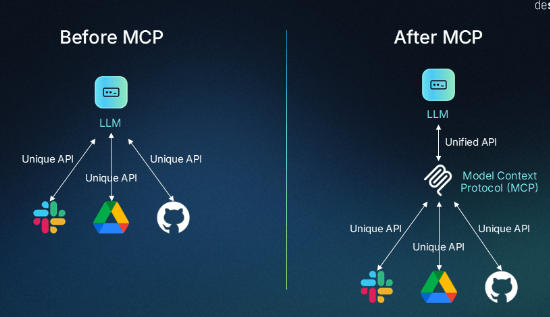
Think of MCP as a universal connector between AI models and the systems they need to interact with.
Before MCP, developers often had to create custom integrations for every tool an AI assistant needed to access. If an AI agent needed to connect to:
- CRM software
- Databases
- File systems
- Email platforms
- Project management tools
- Cloud services
each integration typically required separate code and maintenance.
The MCP protocol simplifies this process by establishing a common communication framework that allows AI models to discover and use tools in a standardized way.
Simply put, if you've ever wondered what is Model Context Protocol, it is a universal communication layer that helps AI agents connect with external systems efficiently and securely.
Why Model Context Protocol Matters
The rise of AI agents has created a major interoperability challenge.
Modern AI applications often need to:
- Retrieve information from databases
- Read documents
- Search internal knowledge bases
- Execute business workflows
- Interact with APIs
- Access enterprise software
Without standardization, every connection becomes a separate engineering project.
This is one reason why Model Context Protocol matters so much.
MCP creates a shared language that enables:
- Easier tool integration
- Faster AI deployment
- Better scalability
- Improved security
- Reduced development costs
As AI ecosystems continue to expand, a universal protocol becomes increasingly valuable.
The Evolution of AI Agent Communication
Traditional AI systems primarily operated in isolation.
A large language model could:
- Generate text
- Answer questions
- Summarize content
However, it couldn't naturally interact with real-world systems.
Developers introduced:
- API integrations
- Plugin architectures
- Function calling systems
- Tool use frameworks
These solutions worked but often lacked consistency.
The need for a standard AI agent communication protocol became clear.
MCP addresses this problem by creating a unified framework that multiple AI systems and software platforms can adopt.
Model Context Protocol Explained
To understand Model Context Protocol explained, imagine an AI assistant working in a company.
An employee asks:
"Show me last month's sales report and create a summary."
The AI agent must:
- Locate the sales report.
- Access company storage.
- Retrieve the file.
- Analyze the data.
- Generate a summary.
- Return the result.
Without MCP:
- Every storage platform requires custom integration.
- Every software tool needs unique code.
- Maintenance becomes complex.
With MCP:
- The AI agent uses standardized MCP connections.
- Tools expose their capabilities through MCP.
- The AI discovers available resources automatically.
- Requests and responses follow a common structure.
The result is a more flexible and scalable ecosystem.
Core Components of MCP Protocol
The MCP protocol generally consists of several key components.
1. MCP Host
The host is the AI application or environment using the protocol.
Examples include:
- AI assistants
- Chatbots
- Coding agents
- Enterprise AI systems
The host initiates communication and requests resources.
2. MCP Client
The client acts as the communication layer between the AI model and external resources.
Responsibilities include:
- Sending requests
- Receiving responses
- Managing protocol interactions
- Handling authentication
3. MCP Server
The MCP server exposes resources and tools.
Examples:
- Database connectors
- File systems
- CRM systems
- Internal business applications
The server provides structured access to information and actions.
4. Resources
Resources are data sources available to AI systems.
Examples include:
- Documents
- Databases
- Knowledge bases
- Customer records
- Project files
Resources provide the context AI agents need.
5. Tools
Tools allow AI models to perform actions.
Examples:
- Sending emails
- Running queries
- Creating tickets
- Updating records
- Scheduling meetings
These tools are exposed through MCP servers.
How Model Context Protocol Works
Many developers ask how Model Context Protocol works in practical environments.
The workflow typically follows these steps.
Step 1: Discovery
The AI agent connects to an MCP server.
The server advertises available:
- Resources
- Tools
- Capabilities
The agent learns what it can access.
Step 2: Request Creation
The user submits a request.
Example:
"Find all open support tickets assigned to John."
The AI determines which MCP tool is required.
Step 3: Tool Invocation
The AI sends a structured request to the MCP server.
The request includes:
- Action type
- Parameters
- Context information
Step 4: Execution
The MCP server performs the requested action.
For example:
- Queries a database
- Searches a document repository
- Retrieves records
Step 5: Response
Results are returned in a structured format.
The AI processes the information and generates a user-friendly answer.
Step 6: Context Enhancement
The retrieved information becomes part of the AI's working context.
This allows more informed responses and follow-up actions.
This process demonstrates how Model Context Protocol works to bridge AI models and external systems.
MCP for AI Agents
One of the most exciting applications is MCP for AI agents.
AI agents are moving beyond simple conversations.
Modern agents can:
- Perform tasks
- Manage workflows
- Coordinate systems
- Execute actions autonomously
To do this effectively, they require reliable access to tools and information.
MCP provides:
- Standardized tool access
- Consistent data retrieval
- Secure communication
- Dynamic capability discovery
As agent-based AI becomes more common, MCP may become a foundational technology.
Benefits of Model Context Protocol
The benefits of Model Context Protocol extend across development, operations, and user experience.
1. Standardization
Perhaps the biggest advantage is standardization.
Instead of building custom integrations for every service, developers can use a common framework.
Benefits include:
- Less code
- Faster implementation
- Easier maintenance
2. Improved Scalability
Organizations often use dozens or even hundreds of software tools.
MCP enables AI systems to scale across multiple platforms without requiring unique integrations for each one.
3. Better Interoperability
Different AI models can interact with the same MCP-enabled tools.
This reduces vendor lock-in and increases flexibility.
4. Faster Development
Development teams spend less time building integrations and more time creating valuable AI experiences.
This accelerates product delivery.
5. Enhanced Security
MCP implementations can centralize:
- Authentication
- Authorization
- Access controls
- Audit logging
This creates more secure AI interactions.
6. Reusable Infrastructure
Once a tool supports MCP, multiple AI systems can use it.
This reduces duplication of effort.
7. Future-Proof Architecture
Because MCP is designed as a standardized protocol, it can adapt to evolving AI ecosystems more easily than custom integrations.
These are some of the most important benefits of Model Context Protocol for organizations adopting AI.
MCP vs Traditional API Integrations
Understanding the difference between MCP and traditional APIs helps illustrate its value.
| Feature | Traditional APIs | MCP Protocol |
|---|---|---|
| Standardized Discovery | No | Yes |
| Dynamic Tool Access | Limited | Yes |
| AI-Friendly Design | Partial | Yes |
| Resource Sharing | Limited | Strong |
| Integration Complexity | High | Lower |
| Reusability | Moderate | High |
Traditional APIs remain important, but MCP provides an AI-focused layer that simplifies tool usage and context management.
Real-World Use Cases
Enterprise Knowledge Management
Organizations store information across:
- Documents
- Wikis
- Databases
- Internal portals
MCP allows AI assistants to access these resources consistently.
Customer Support Automation
AI support agents can:
- Retrieve customer records
- Check order status
- Update tickets
- Escalate issues
through MCP-enabled systems.
Software Development
Developer agents can:
- Read repositories
- Access documentation
- Execute code analysis
- Manage pull requests
using MCP-connected tools.
Business Operations
AI assistants can automate:
- Reporting
- Scheduling
- Data entry
- Workflow management
by connecting through MCP.
Research and Analysis
Researchers can use AI agents that retrieve information from:
- Internal databases
- Scientific repositories
- Company knowledge systems
while maintaining a consistent workflow.
Security Considerations
While MCP offers powerful capabilities, security remains critical.
Organizations should implement:
Authentication
Only authorized AI systems should access MCP servers.
Authorization
AI agents should only access approved resources.
Encryption
Data should be encrypted during transmission.
Logging and Auditing
Every interaction should be traceable.
This supports compliance and security monitoring.
Least-Privilege Access
Agents should receive only the permissions necessary for their tasks.
This minimizes risk.
Challenges and Limitations
Although MCP offers significant advantages, it is not without challenges.
Adoption
Protocols become more valuable when widely adopted.
Organizations may need time to transition existing systems.
Complexity
Large environments can involve numerous MCP servers and resources.
Proper architecture planning is important.
Governance
As AI gains access to more tools, governance becomes essential.
Organizations need policies regarding:
- Tool access
- Data usage
- Agent permissions
Performance
Excessive tool calls may introduce latency.
Efficient implementation is necessary.
Model Context Protocol Tutorial: Basic Workflow
This simplified Model Context Protocol tutorial demonstrates a typical interaction.
User Request
"Generate a report of sales from the last quarter."
AI Agent Actions
- Identify required data.
- Discover available MCP tools.
- Connect to reporting database.
- Retrieve sales records.
- Analyze data.
- Generate report.
MCP Role
The protocol handles:
- Tool discovery
- Data retrieval
- Structured communication
- Response formatting
The AI focuses on reasoning while MCP manages system connectivity.
This simple example illustrates a practical Model Context Protocol tutorial scenario.
The Future of MCP
As AI agents become more autonomous, protocols like MCP will likely play a larger role.
Future developments may include:
- Broader industry adoption
- More MCP-enabled applications
- Improved security frameworks
- Cross-platform interoperability
- Enhanced agent collaboration
The growth of agent-based AI systems makes standardized communication increasingly important.
Organizations seeking scalable AI solutions may view MCP as a critical component of their technology stack.
Why Model Context Protocol Matters for the Future of AI
The next generation of AI will not simply answer questions.
AI systems will:
- Execute tasks
- Manage workflows
- Coordinate applications
- Access enterprise knowledge
- Operate across software ecosystems
These capabilities require a reliable AI agent communication protocol.
The Model Context Protocol addresses this need by creating a standardized method for connecting AI models with tools, data sources, and services.
When considering why Model Context Protocol matters, the answer is simple: it helps transform AI from a standalone assistant into an active participant within digital ecosystems.
By enabling interoperability, scalability, security, and reusable integrations, MCP has the potential to become one of the foundational technologies powering the future of AI agents.
Conclusion
The Model Context Protocol (MCP) represents a major step forward in AI infrastructure. It provides a standardized framework that allows AI models and agents to interact with tools, resources, databases, and external systems more effectively.
Understanding what is Model Context Protocol, how Model Context Protocol works, and the many benefits of Model Context Protocol is becoming increasingly important for developers, businesses, and technology leaders.
As AI adoption continues to grow, MCP for AI agents offers a practical solution to one of the industry's biggest challenges: seamless communication between intelligent systems and the software environments they operate in. Organizations that embrace MCP early may gain significant advantages in scalability, automation, and AI-driven productivity in the years ahead.
More Articles
 26 Jun 2026
How to Generate Leads Online: Business Strategies
Boost business growth with proven strategies for generating leads online, increasing conversions and driving sales success.
 24 Jun 2026
What Is Indexing? How Google Finds Your Website
Clear guide to what is indexing, covering Google indexing and methods to improve website visibility in search engines.
 23 Jun 2026
Business Website ROI: Is It Worth the Investment?
Discover the true business website ROI, how to measure website return on investment, calculate conversions, generate leads, and determine whether a professional business website is worth the investment.
 17 Jun 2026
Best AI Apps for Smartphones in 2026
The best AI apps for smartphones in 2026 enhance productivity and daily tasks with powerful, smart mobile solutions.