Public vs. Private Cloud: Which One Is Right for Business?
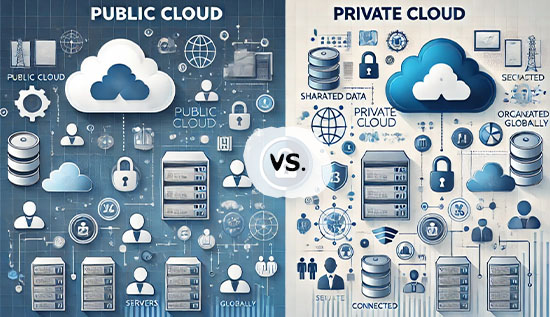
Explore the differences between public and private cloud models, benefits, costs, and how to choose the right cloud for your business.
Cloud computing for companies has become pillar of operational efficiency and creativity as companies utilize digital technology more and more. Among the several approaches of cloud deployment, the decision usually comes down to public vs private cloud.
Every model presents different advantages, drawbacks, and use cases that companies have to assess to decide which meets their requirements most. This paper offers a detailed analysis of the advantages of the public vs private cloud, thereby guiding your choice of cloud model for your company.
What is Cloud Computing for Businesses?

The supply of cloud computing for businesses —including servers, storage, databases, networking, software, and analytics—over the internet (the "cloud"). Company run apps, store data, and handle workloads using these services. In the competitive scene of today, cloud service is indispensable because of their scalability and adaptability.
Among the popular cloud deployment models, the public cloud and private cloud implementation. Let’s delve deeper into these cloud deployment models to understand their unique features and applications.
Understanding Public Cloud and Its Benefits
Shared among several companies, a public cloud is a cloud infrastructure housed by outside public cloud providers such as Amazon Web Services (AWS), Microsoft Azure, and Google Cloud. Companies pay just for what they consume as they use these services online.
Read more: Cloud Engineer Jobs for Freshers | AWS | Google Cloud
Public Cloud Benefits
There are 4 pointed which is related to public cloud benefits:
1. Cost-Effectiveness: Public clouds operate on a pay-as-you-go model, eliminating the need for upfront capital investment in IT infrastructure. This model significantly reduces the cost of public vs private cloud, making it ideal for startups and small businesses.
2. Scalability in Cloud Services: Public clouds have unmatched scalability given almost infinite resources. Companies free from infrastructure constraints can readily adjust their operation depending on demand as up or down.
3. Accessibility and Flexibility: Accessible from anyplace with an internet connection, public cloud services support remote work also worldwide cooperation.
4. Managed Services: By handling security, updates and maintenance, top public cloud providers let companies to concentrate on their main operations.
Though There are public cloud benefits, some companies are reluctant to use this model totally due to security issues and restricted data control.
Exploring Private Cloud and Its Advantages
Unlike the public cloud, a private cloud is a specifically used dedicated cloud infrastructure employed by one company. Though the resources are not shared with other companies, it can be housed on-site or by a third-party vendor.
Private Cloud Advantages
1.Enhanced Security: Cloud security comparison emphasizes repeatedly that because of their exclusive character, private clouds provide better security standards. Companies including sensitive data—such as those in the financial or healthcare sectors often choose private clouds.
2.Data Control in Cloud Computing: By giving companies complete control over their infrastructure, apps and data, private clouds guarantee industry compliance with standards and laws.
3.Customization: Organizations can tailor their private cloud environments to meet specific needs, ensuring optimal performance and efficiency.
4.Performance Stability: By customizing their private cloud systems to fit particular requirements, companies may guarantee best performance and economy.
5.Despite these private cloud advantages: the model requires significant investment in infrastructure and maintenance, making it less cost-effective compared to the public cloud.
Key Differences: Public vs Private Cloud
To make an informed decision, businesses must understand the critical differences between the public vs private cloud models:
1.Cost: As was already noted, public Vs private cloud have somewhat different costs. For small-scale operations, public clouds are more affordable; for large-scale, data-intensive companies, private clouds are better fit.
2.Scalability: Public clouds excel in scalability due to their resource pooling, whereas private clouds are limited by the organization’s infrastructure.
3.Security and Control: Perfect for companies handling private data, private clouds provide exceptional security and management. Although safe, public vs private cloud could not satisfy some sectors' strict compliance standards.
4.Maintenance: Public cloud providers manage the infrastructure and updates, whereas private clouds require dedicated IT teams for maintenance.
Hybrid Cloud: The Best of Both Worlds?
Many businesses are opting for a hybrid cloud approach, combining the public cloud benefits with private cloud advantages. A hybrid cloud lets companies distribute tasks depending on particular requirements across public and private clouds. For example, whilst a public cloud handles less important operations, sensitive data can be kept in a private cloud.
For companies trying to maximize their IT plans and the hybrid approach presents cost-efficiency, scalability with flexibility.
Choosing the Right Cloud Model for Your Business
When choosing the right cloud model, therefore consider the following factors:
1.Clearly explain your corporate objectives and evaluate how each model matches them.
2. Analyze any model's financial results in view of running costs and upfront investment.
3.Find the degree of security and control your data calls for.
4. Should your company need a stable infrastructure or on-demand scalability, think about that.
5.Make sure the selected model follows industry guideline and standards.
Conclusion
The argument between public Vs. private clouds turns mostly on the particular needs of your company. Public clouds are scalable and reasonably priced; private clouds give more security and control. Many firms find that a hybrid cloud solution offer the best of both world.
By carefully assessing your needs and weighing the public cloud benefits against the private cloud advantages. you can make an informed decision that drives your business forward.
Frequently Asked Questions
1. How vary public Vs. private cloud?
Whereas the private cloud is a dedicated environment only for one company, the public cloud is a shared infrastructure run by outside vendors.
2. Public clouds are safe?
Public clouds are safe, but they might not satisfy the rigorous standards for compliance in sectors such as finance or healthcare.
3.Which companies would want to use a private cloud?
For more security and control, company managing sensitive data such as government agency or financial institutions—should give private cloud some thought.
4. How much more or less public than private clouds cost?
While private clouds need large upfront investment, public clouds run on a pay-as---you-go model and are therefore affordable for small-scale companies.
5. Can I mix public and private clouds?
Indeed, many companies mix security, pricing, and scalability using a hybrid cloud approach.
6. How do suppliers of public clouds handle data?
To guarantee data security, public cloud providers apply cutting-edge encryption and security mechanisms.
7. What elements should guide my choice of a cloud model?
Choose a cloud model based on your company goals, budget, data sensitivity, scalability needs and regulatory requirement.
More Articles
 27 Oct 2026
Core Web Vitals Explained: Metrics & How to Fix Them
Learn what Core Web Vitals are, how LCP, INP, and CLS affect user experience and SEO, and practical ways to fix performance issues and improve your website.
 23 Oct 2026
Website Audit Score: How to Check and Improve It
Check your website audit score, identify SEO issues, improve technical performance, site health and search visibility.
 21 Oct 2026
Low-Value Content: How to Identify and Fix It
Identify low-value content, improve content quality and fix SEO issues with practical strategies to boost website usefulness.
 20 Oct 2026
Session Hijacking: How It Works and How to Prevent It
Learn what session hijacking is, how session cookie theft works, common attack signs, and effective prevention strategies to protect accounts and web applications.