Voice Clone Scams: How to Spot AI Voice Scams
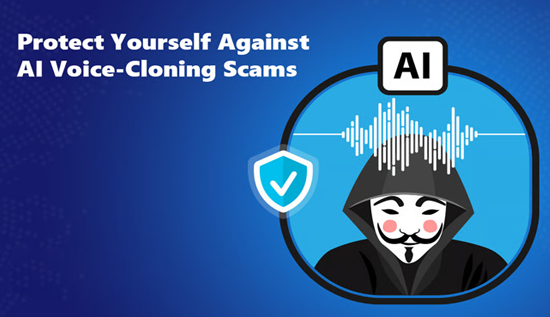
Learn how voice clone scams work, how criminals use AI-generated voices, and how to spot AI voice scams before you send money or share sensitive information.
Artificial intelligence has made voice technology remarkably realistic. Today, software can analyze a short recording of someone's speech and generate new audio that sounds similar to that person. While voice cloning has legitimate uses in accessibility, entertainment, education, and business, criminals can also abuse the technology.
This has led to a growing concern around voice clone scams and AI voice scams. A scammer may imitate a family member, friend, manager, customer-service representative, or another trusted person and use the cloned voice to create a convincing emergency or urgent request.
The danger is not simply that the voice sounds realistic. Scammers combine AI-generated audio with familiar names, stolen personal information, spoofed phone numbers, and pressure tactics. The goal is to make victims react emotionally before they have time to verify what is happening.
Understanding AI voice cloning scams can help you recognize suspicious calls and messages. This guide explains what voice cloning is, how do voice clone scams work, common warning signs, how to spot a voice cloning scam, and practical ways to verify suspicious requests.
What Are Voice Clone Scams?
Voice clone scams are fraudulent schemes in which criminals use AI-generated or manipulated audio to imitate a real person's voice. The fake voice may be used during a phone call, voicemail, voice message, video, or other communication.
For example, you might receive a call that appears to come from someone you know. The caller sounds like that person and says there is an urgent problem. They might claim they have lost their phone, are traveling, have been involved in an emergency, or urgently need financial assistance.
The voice may sound convincing enough to make you believe the caller's identity without asking additional questions.
A voice cloning scam can target individuals, families, employees, and businesses. In some cases, criminals pretend to be executives or colleagues and ask employees to make payments or reveal information.
The important point is that a familiar-sounding voice is not proof of identity.
What Is AI Voice Cloning?
AI voice cloning is technology that can generate speech resembling a particular person's voice.
A voice-cloning system can learn characteristics such as:
- Speech patterns
- Pronunciation
- Vocal tone
- Rhythm
- Pitch
- Accent
- Speaking style
Once a model has enough information, it may generate new speech that resembles the source speaker.
Legitimate voice cloning can have useful applications. For example, people who have lost their ability to speak may use personalized synthetic voices. Companies can also use synthetic speech for certain accessibility or media applications.
The technology itself is not necessarily fraudulent. The problem occurs when criminals use it to impersonate someone and deceive another person.
That misuse is what creates AI voice scams and voice cloning fraud.
How Do Voice Clone Scams Work?
Understanding how do voice clone scams work is one of the best ways to recognize them.
Although individual scams differ, many follow a similar sequence.
1. The Scammer Finds a Voice Sample
Criminals may search for publicly available recordings of a target.
Potential sources can include:
- Social media videos
- Public interviews
- Podcasts
- Livestreams
- Online presentations
- Videos posted by friends or relatives
- Business websites
A scammer doesn't necessarily need hours of recordings. Modern AI tools can work with relatively short voice samples, although the quality and amount of source material can affect the result.
2. The Voice Is Used to Generate Fake Speech
The criminal uses voice-generation technology to create audio that resembles the target.
The generated speech can potentially say things that the real person never said.
This makes the scam particularly dangerous because victims may recognize the voice while having no reason to expect that the audio itself could be fabricated.
3. The Scammer Creates a Story
The fake voice usually isn't enough by itself.
Scammers often build an emotionally convincing scenario. They might claim:
- "I'm in trouble."
- "I need help immediately."
- "My phone isn't working properly."
- "I'm dealing with an emergency."
- "Please don't tell anyone."
- "I need you to transfer money."
- "I need your verification code."
These statements are designed to create urgency.
4. The Victim Is Pressured to Act
The scammer may discourage the victim from checking the story.
They can create pressure by saying the situation is time-sensitive or that contacting someone else will make the problem worse.
This is an important warning sign.
When someone asks you to make a financial or security-related decision immediately, slow down and verify independently.
Common Types of AI Voice Scams
There isn't just one type of AI voice scam. Criminals can adapt voice cloning to different fraud scenarios.
Family Emergency Scams
A scammer may imitate a relative and claim they urgently need money.
The story could involve a supposed accident, lost phone, travel problem, or another emergency.
The scam works because the victim may become frightened and focus on helping rather than verifying the caller.
Executive Impersonation
Businesses can face AI voice cloning scams involving executives or managers.
A criminal may pretend to be a company leader and ask an employee to:
- Send money
- Change payment details
- Share confidential information
- Purchase something
- Provide account information
This type of fraud can be especially dangerous when employees are accustomed to receiving urgent instructions from senior staff.
Customer Support Impersonation
Scammers may pretend to represent banks, technology companies, delivery companies, or other organizations.
The fake representative may ask for:
- Passwords
- One-time codes
- Account details
- Payment information
- Identity information
A legitimate organization generally should not require you to hand over sensitive authentication credentials simply because someone called you.
Romance and Social Engineering Scams
Fraudsters can use AI-generated voices alongside fake online identities.
After establishing trust through messages or social media, the scammer may eventually introduce a voice call. Hearing a convincing voice can make the fictional identity seem more genuine.
Investment Scams
Some scammers combine fake voices with investment pitches.
A criminal may impersonate an advisor, businessperson, or supposed successful investor and encourage the victim to send money.
The voice is intended to increase credibility.
Business Payment Fraud
Organizations should also be alert to voice-based impersonation.
For example, a criminal could attempt to convince an employee that a supplier or executive has changed payment instructions.
Because payment fraud can involve substantial amounts, businesses should have verification procedures that don't depend on recognizing someone's voice.
How to Spot a Voice Cloning Scam
Knowing how to spot a voice cloning scam requires looking beyond the sound of the voice.
A convincing voice can still accompany a completely fake story.
Watch for these warning signs.
1. The Caller Creates Extreme Urgency
Urgency is one of the strongest social-engineering techniques.
Be cautious if the caller insists you must act immediately.
Statements such as "send it now," "don't call anyone else," or "there's no time to verify" should increase your suspicion.
2. The Caller Requests Money
An unexpected request for money should always be independently verified.
This is especially important if the caller claims to be a relative or someone you know.
Instead of relying on the voice, contact that person through a phone number or communication channel you already trust.
3. The Caller Asks for Sensitive Information
Never assume a caller is legitimate simply because the voice sounds familiar.
Be particularly careful with requests for:
- Passwords
- PINs
- Authentication codes
- Banking details
- Identity information
- Account recovery information
4. The Story Seems Unusual
Ask yourself whether the situation matches the person's normal behavior.
Would your family member normally ask you to send money in this way?
Would your manager normally request a payment through an unfamiliar channel?
Would a company representative really ask for information they should already have?
An unusual request deserves additional verification.
5. The Caller Discourages Verification
This is a major red flag.
A legitimate person should generally understand why you want to confirm an unusual request.
Scammers may instead become impatient, angry, emotional, or threatening when you attempt to verify their identity.
6. The Audio Sounds Slightly Unnatural
AI-generated speech can sometimes contain unusual characteristics.
For example, you might notice:
- Strange pauses
- Unusual rhythm
- Robotic transitions
- Odd pronunciation
- Inconsistent emotional expression
- Unnatural breathing
- Sudden changes in tone
- Words that don't quite match the speaker's normal style
However, these signs are not reliable on their own. AI-generated audio can be highly convincing, and poor phone connections can make genuine voices sound unusual.
How to Tell If a Voice Is AI Generated
People often ask how to tell if a voice is AI generated.
The difficult truth is that there isn't always a simple listening test.
Modern synthetic voices can sound remarkably natural. Meanwhile, genuine calls can contain distortion because of microphones, compression, background noise, or poor network connections.
Therefore, don't make your decision solely based on audio quality.
Instead, combine several signals.
Listen for Inconsistencies
Pay attention to whether the voice behaves differently from what you normally expect.
Does the person's emotional reaction make sense?
Does the speaking rhythm sound unusual?
Does the person pronounce familiar names differently?
These clues may be useful, but they are not definitive proof.
Ask Unexpected Verification Questions
If you suspect someone is impersonating a person you know, ask something that isn't easily available from public information.
For example, you might ask about a shared experience or an ordinary detail that a genuine person would know.
Don't rely on a single secret question as a perfect security system, though. Personal information can sometimes be discovered online.
Contact the Person Separately
This is much stronger than trying to analyze the audio.
End the suspicious call and contact the supposed caller using a number you already have saved.
Don't simply call back the number that contacted you.
If the real person answers and says they never called, you've identified the scam.
How to Detect an AI Cloned Voice
Learning how to detect an AI cloned voice can help, but consumers should understand the limitations.
AI-detection tools may analyze audio for characteristics associated with synthetic speech. However, detection technology isn't perfect, especially as voice-generation systems continue to improve.
For everyday protection, behavioral verification is usually more useful than attempting to become an expert audio analyst.
Use this approach:
Voice + story + request + verification
Ask:
- Who is contacting me?
- What are they asking me to do?
- Why is the request urgent?
- Is the request normal for this person?
- Can I verify it through another channel?
If the request involves money or sensitive information, independent verification should be a standard step.
Voice Clone Scam vs. Traditional Impersonation
Traditional impersonation scams existed long before generative AI.
A criminal could simply claim to be someone's relative or colleague.
AI changes the situation because the scammer can potentially make the impersonation much more convincing.
| Traditional Impersonation | AI Voice Scam |
|---|---|
| Relies primarily on claims | Can imitate a person's voice |
| Voice may not match the target | Voice can sound highly familiar |
| Easier to question identity | Familiar voice may create instant trust |
| Often depends on social engineering | Combines social engineering with synthetic media |
| Verification remains important | Independent verification is especially important |
The central defense remains the same: verify the identity independently.
Why Voice Clone Scams Are So Effective
The human brain naturally uses voices as identity signals.
When you hear someone you know, you may recognize them automatically without consciously analyzing every characteristic of their speech.
Scammers exploit this automatic trust.
There is also an emotional component.
If someone who sounds like a close family member says they are in trouble, you may react emotionally before considering whether the call is authentic.
This is why voice cloning fraud is fundamentally a social-engineering problem as much as a technology problem.
The technology creates the convincing voice. Psychological manipulation creates the pressure to act.
What to Do If You Receive a Suspicious AI Voice Call
If you suspect a caller may be using a cloned voice, don't panic.
Follow a simple process.
Step 1: Stop and Slow Down
Don't immediately transfer money or disclose information.
Take a moment to think.
Step 2: End the Conversation
You don't need to continue talking to prove whether the caller is legitimate.
Politely end the call if necessary.
Step 3: Contact the Real Person
Use a trusted phone number, messaging account, or another communication method.
Don't rely on the contact information provided during the suspicious call.
Step 4: Verify the Story
Ask whether the person actually contacted you and whether the request is genuine.
Step 5: Protect Your Accounts
If you already shared sensitive information, change affected passwords and use your account provider's official security procedures.
If financial information was disclosed or money was sent, contact the relevant financial institution promptly and explain what happened.
Step 6: Report the Scam
Depending on where you live, suspicious fraud can be reported to appropriate law-enforcement authorities, financial institutions, telecommunications providers, or online platforms.
Reporting can help organizations identify patterns and warn other people.
How to Protect Yourself From AI Voice Scams
Prevention is easier when you establish good habits before receiving a suspicious call.
Create a Family Verification Rule
Families can agree on a simple rule:
Unexpected emergency + money request = verify through another channel.
This removes the need to make a decision while frightened.
Use a Private Verification Phrase Carefully
Some families may choose a shared phrase for emergencies.
However, don't post the phrase online or share it unnecessarily. Treat it like a security measure.
Limit Public Voice Content
If you frequently post videos or audio publicly, understand that recordings may potentially be reused by others.
This doesn't mean you need to stop posting online. Instead, consider what personal information is publicly available and who can access it.
Use Strong Account Security
Protect social media and email accounts with strong, unique passwords and multi-factor authentication where available.
If criminals gain access to your accounts, they may obtain additional information that makes impersonation more convincing.
Educate Older Family Members
Older relatives can be particularly vulnerable to emergency-style fraud if they aren't familiar with AI-generated audio.
Explain that hearing a familiar voice isn't enough to confirm someone's identity.
What Businesses Can Do About AI Voice Scams
Companies should not depend on voice recognition for high-risk transactions.
Businesses can establish procedures such as:
- Requiring secondary approval for significant payments
- Verifying payment-detail changes through a trusted channel
- Using written confirmation for important financial instructions
- Separating payment approval from payment execution
- Training employees about synthetic-media fraud
- Establishing clear escalation procedures
- Using multi-factor authentication for sensitive systems
These controls are valuable because even a highly convincing fake voice shouldn't be enough to authorize a financial transaction.
Common Mistakes People Make
Understanding common mistakes can make AI voice scams easier to avoid.
Mistake 1: Trusting a Familiar Voice
A recognizable voice doesn't automatically prove identity.
Mistake 2: Acting Under Pressure
Urgency can interfere with careful decision-making.
Mistake 3: Calling the Number Provided by the Scammer
If you suspect fraud, use a trusted contact method instead.
Mistake 4: Assuming AI Detection Is Perfect
There is no universal listening trick that can reliably identify every synthetic voice.
Mistake 5: Sharing Verification Codes
One-time codes and authentication information should be treated as highly sensitive.
Can AI Voice Scams Be Completely Prevented?
Unfortunately, no security measure can guarantee that you will never encounter a voice clone scam.
Voice-generation technology continues to evolve, and criminals can combine synthetic audio with other forms of deception.
However, you can significantly reduce the risk by changing one important habit:
Don't treat a voice as sufficient proof of identity.
When an unexpected caller requests money, confidential information, or an unusual action, verify the request independently.
This approach remains effective even when the cloned voice sounds extremely realistic.
Voice Clone Scam Warning Signs Checklist
Before responding to an unexpected voice message or call, ask:
- Is the request unexpected?
- Is the caller creating urgency?
- Are they asking for money?
- Are they requesting sensitive information?
- Are they telling me not to contact anyone else?
- Does the situation seem unusual?
- Does the voice sound slightly unnatural?
- Is the caller using an unfamiliar number?
- Can I verify the identity independently?
- Would I make the same decision if I weren't under pressure?
If several answers raise concerns, stop and verify.
Final Thoughts
Voice clone scams demonstrate how artificial intelligence can make traditional social engineering more convincing. A scammer no longer has to rely solely on pretending to be someone. With AI-generated speech, they may be able to create audio that sounds remarkably similar to a real person.
Understanding how do voice clone scams work makes these schemes easier to recognize. The most important lesson is that you shouldn't rely on your ears alone.
If an unexpected caller asks for money, passwords, authentication codes, or other sensitive information, pause before acting. End the conversation if necessary and contact the supposed caller through a trusted channel.
Knowing how to spot a voice cloning scam, how to tell if a voice is AI generated, and how to detect an AI cloned voice can help you recognize suspicious situations. But you don't need to become an audio expert.
The strongest defense is simple: verify the person, verify the story, and verify the request before taking action.
More Articles
 09 Oct 2026
Fake ChatGPT Websites: How to Spot a Scam
Protect your accounts and devices by recognizing fake ChatGPT websites, phishing scams and fraudulent AI applications.
 07 Oct 2026
Browser-in-the-Browser: How Hackers Steal Passwords
Browser-in-the-Browser attacks trick users with fake login windows, real examples and practical ways to protect your passwords.
 07 Oct 2026
QR Code Scams in Cambodia: How to Spot Fake QR
Learn about QR code scams in Cambodia, fake KHQR payments, warning signs, and simple ways to check QR codes and stay safe when making digital payments.
 02 Oct 2026
Best Password Managers: Free & Secure Options
Compare the best password managers, including free and secure options, with key features and practical security tips.